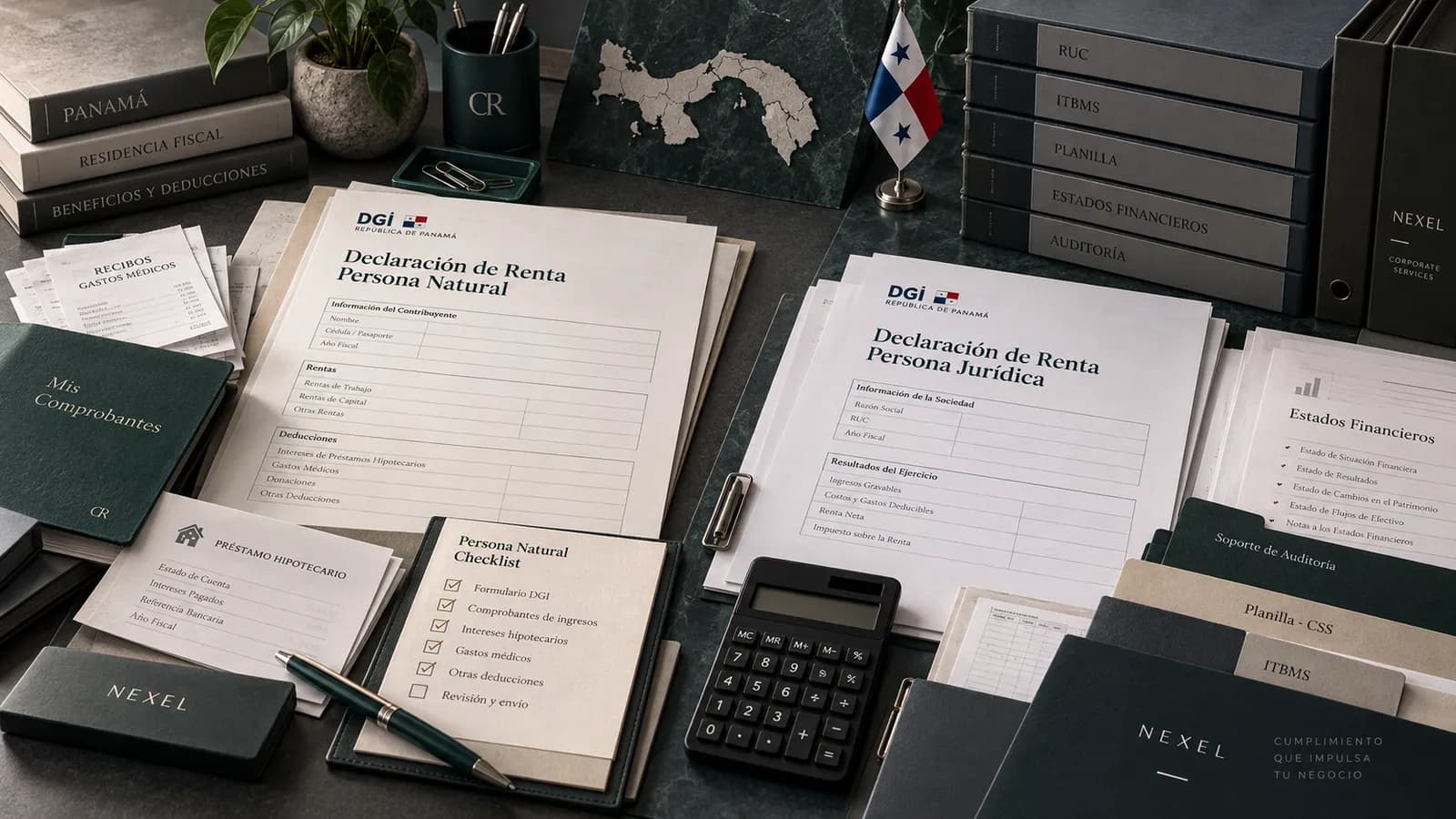
RUC in Panama: Corporate Registration, Updates & Ongoing Tax Obligations

Getting a tax number is the beginning—not the end—of tax compliance
A person or company may obtain a Panamanian tax registration number to open a business, formalize a transaction, register an asset or complete a specific filing. Yet a successful registration does not establish whether that person must file an annual tax return, charge ITBMS, maintain accounting records, obtain an electronic invoicing solution or meet local municipal obligations. Those questions arise from the taxpayer's actual legal and economic circumstances.
For readers still deciding which registration route applies to them, CitizenResident provides a separate international-client-oriented guide to RUC, NT and NIT in Panama. This NEXEL CPA article focuses on what happens after the identification is obtained, when corporate registration becomes necessary and what ongoing financial and tax controls deserve attention.
When does a newly incorporated Panamanian company need its own RUC?
A corporation, foundation or other legal entity is not the same taxpayer as its directors, shareholders or beneficial owners. Its registration should therefore be evaluated separately from the personal RUC or tax number of the individuals involved. The DGI's corporate RUC guidance states that legal entities are required to register within the month following their registration with Panama's Public Registry. DGI registration itself is an official free procedure; professional review and coordination, where retained, are separate services.
Incorporation, Public Registry entry, a corporate RUC, an Aviso de Operación when applicable, municipality-level registration, invoicing arrangements and the taxpayer's e-Tax account are related but distinct matters. Being incorporated does not, by itself, prove that all those registrations or obligations have been satisfied. Conversely, a company that holds assets or conducts business only outside Panama should not be assigned an identical set of filing obligations without an assessment of its activities and tax status.
What if the company was incorporated years ago but nobody has checked its DGI account?
Older companies may have a tax registration that was never fully activated, correspondence sent to an outdated email address, a representative no longer in office, unreviewed tax-account balances or unpaid annual entity charges. Before concluding that a company is compliant—or inactive—its records should be reconciled across the Public Registry, DGI, accounting files and any relevant municipal or regulatory authorities.
For certain Panamanian entities, tasa única is an annual legal-entity charge distinct from income tax. The DGI publishes guidance concerning annual charges, late-payment surcharges and possible suspension consequences. Whether a company must also submit an income tax return, ITBMS returns or other declarations depends on the applicable rules and its particular facts; an absence of sales does not automatically resolve every obligation. See the DGI guidance on tasa única.
Which changes should prompt a review or update of the RUC record?
A practical review is advisable after changes to registered address, tax domicile, email contact, economic activities, legal representation, establishment details or other taxpayer information held by DGI. Not every change is supported by the same documentary evidence and some require analyst approval. The DGI explains that taxpayers can access e-Tax 2.0, select the RUC section and use Solicitud de Actualización RUC; if attachments are requested, the submission may require review by a DGI analyst. Official DGI RUC questions.
Importantly, a shareholder transfer or appointment of a new director should not simply be treated as a generic 'change of RUC number.' The company remains the same legal entity unless its status or structure changes under the applicable rules. The practical task is to determine which tax, registry, representative and contact details must be updated and to maintain consistent supporting evidence.
Was there an extraordinary RUC update deadline?
Yes. During 2025 the DGI launched a mandatory updating campaign for natural and legal persons, subsequently extending its deadline to 31 December 2025. That was a specific historical compliance campaign, not a new blanket deadline for 2026. The requirement to maintain truthful and current information remains relevant independently of past campaigns. The DGI's announcement cited potential penalties of B/.100–500 for failure to update or for insufficient or incorrect information under the cited framework. DGI extension notice and original penalty notice.
A company that missed that campaign should seek a case-specific review of its current record and applicable remedies instead of assuming that submitting an online form erases any existing exposure or that an expired campaign date is the next ordinary filing deadline.
What is the NIT, and who should control access to e-Tax 2.0?
In Panama's DGI system, the NIT (Número de Identificación Tributaria) is the personal access credential used together with the RUC to enter e-Tax 2.0; it is not a replacement for the corporate or personal registration number. DGI indicates that the NIT must be changed every six months. The registered email address is therefore an operational control, not a minor administrative detail. DGI: NIT and account security.
When changing accountants or administrators, a business should verify who controls the registered email, ensure authorized access is restored through official procedures, and retain reliable records of filings and notices. Access credentials should not be informally transferred as if they were company property to be shared without controls.
Does registering a RUC automatically mean an annual income tax return must be filed?
No single answer applies to every registrant or every entity. The relevant analysis includes legal form, type and source of income, activity in Panama, applicable exemptions or special regimes, prior filings and the taxpayer's current obligations shown by DGI. For taxpayers obliged to file, DGI generally identifies 15 March for natural persons and 31 March for legal entities after the relevant calendar fiscal year, with specific rules for approved special fiscal years and filing extensions. Filing extensions do not necessarily extend payment deadlines. DGI income tax filing deadlines.
Consequently, neither possessing a RUC nor operating through a corporation should be used as a substitute for a tax-position review. A taxpayer may need to file, document non-applicability, resolve historic periods or address another declaration altogether. NEXEL can distinguish ongoing bookkeeping from the separate professional work of preparing and filing a tax return.
When do ITBMS, electronic invoicing and payroll obligations become relevant?
These obligations are determined by activities and legally applicable thresholds, not simply by receiving a tax number. DGI guidance identifies the B/.36,000 annual turnover threshold for ITBMS in ordinary qualifying cases, with important sectoral and activity-specific rules. ITBMS may involve monthly filings and, for particular independent professional-service arrangements, quarterly filing regimes. The precise classification should be reviewed rather than assumed. DGI ITBMS guidance and Form 430.
Businesses also need to evaluate the invoicing method appropriate to their activity, customer profile and regulatory obligations. If employees are hired, CSS registration, payroll reporting, withholding and related declarations may be triggered. These are separate compliance workstreams and should not be presented as automatically included in tax-number registration or ordinary bookkeeping packages.
What penalties can result from neglected tax administration?
The consequences differ according to the infraction: incomplete RUC information, late income tax returns, missed ITBMS declarations, unpaid taxes, annual entity charges or missing accounting records do not share one universal fine. The DGI's published materials describe, for example, possible B/.100–500 penalties within the 2025 RUC updating campaign and penalties for certain late corporate income-tax returns that may range from B/.500 to B/.1,000. Interest, surcharges, enforcement or corporate-status consequences may arise separately depending on the obligation. DGI filing penalties FAQ.
These figures are examples from official guidance, not a personalized penalty quote. The applicable amount, defenses, deadlines and current account status need individual confirmation before a client acts. A procedural update alone should not be treated as proof that all prior filings, payments or statutory duties are up to date.
What should property owners and international shareholders check?
A parcel of real estate may have its own property RUC/account at DGI, separate from a person's or company's taxpayer identification. Municipal registration and local business taxes are separate from the DGI account as well. Property owners should reconcile the registration, ownership changes, ANATI information and any real-estate tax obligations relevant to their property. Shareholders should distinguish a personal identification requirement for a share transaction from the standing RUC and annual compliance duties of the Panamanian company whose shares are being transferred.
That is why the international-client guide on CitizenResident focuses on choosing the correct initial procedure, whereas the present article concerns accounting continuity, record integrity and the practical duties that follow.
How does NEXEL CPA support responsible RUC maintenance?
NEXEL CPA approaches a tax record as part of a broader compliance system rather than as a one-time administrative form. Depending on the engagement, its professionals can review the DGI account alongside corporate and accounting records, identify outdated information and pending filings, assess the appropriate tax reporting position, organize supporting documents, reconcile account movements and coordinate relevant updates and recurring declarations.
Where an issue requires corporate resolutions, a notarial act, a change at the Public Registry, legal representation or other legal opinions, that work should be coordinated with the competent legal professionals. NEXEL's bookkeeping, income tax preparation and tax consulting are distinct engagements; an initial RUC review does not automatically include every filing, rectification or administrative action.
Before you request assistance
The most useful starting point is to identify the taxpayer (individual, legal entity or property), its existing RUC and e-Tax status, the reason it was registered, whether its activity or representation has changed, and which accounting periods or filings may be open. The objective is to establish a defensible compliance position and a realistic scope of work—not to presume that every number requires a new registration or that every inactive-looking account has zero obligations.
This article is general educational information, not individualized tax or legal advice. Regulations, DGI procedures and the taxpayer's actual circumstances govern the outcome. Confirm current requirements and your account position with the relevant authority and qualified professionals.